 ObjectExplorer
 Draw facing the audience shouldn't be that hard
Draw on the glass. Face to root.
The best way to explain an idea is to draw it. A sketch easily turns a complex problem into a simple one. The most natural pose for explaining is facing the audience. A lightboard is the one way I know to do both at once.
The whiteboard way
A whiteboard faces the room, which means the person drawing on it faces the wall. You talk into the board. Your hand covers each word as you write it, so you step aside to let people read, then turn back for the next line. On camera it gets worse: the lens sees mostly shoulders, and the face, the part that makes an explanation feel like a person talking, is missing for most of the minute.
So most people stop drawing and make slides. Slides are clear, but nothing gets worked out in front of anyone any more.
- Whiteboardturn my back
- Markerhand hides words
- Camerafilms my shoulders
- Slidesstop drawing
The whiteboard did nothing wrong. It is a wall you write on, and a wall is opaque. Every step above shares one assumption: the board stands behind or beside the speaker, so the audience and the drawing can never be in the same direction.
The lightboard way
What I want is a face and a drawing in one picture, both pointed at the camera. So the board has to stand between me and the camera, and both of us have to see through it. That means glass.
Ink on plain glass is hard to see. So the light goes into the glass instead. An LED strip along the bottom edge shines up into the sheet, and the light stays trapped inside it. Ink lets it out. So the ink glows and the clear glass stays dark.
Two small things finish it. Glass reflects whatever is in front of it, so a dark curtain hangs behind the camera. And the camera sees the writing backwards, so the video is flipped once afterwards.
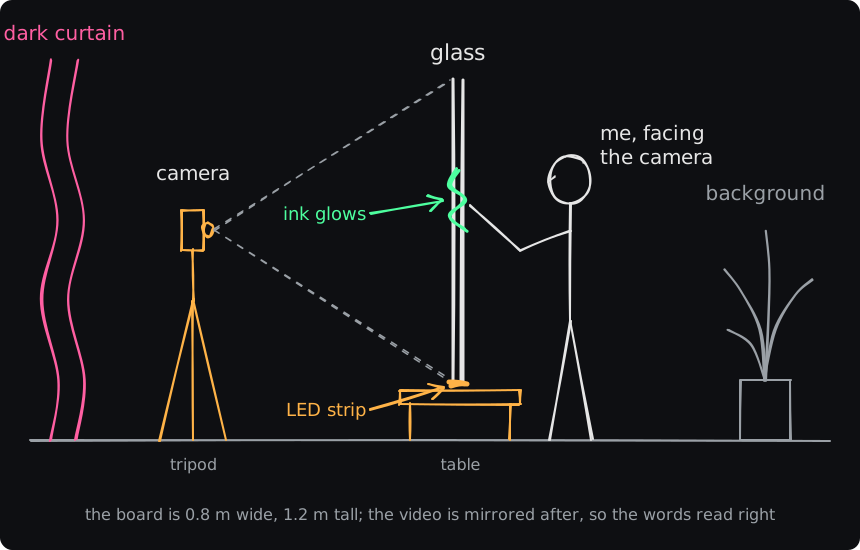
This is the video of mine:
The three lines of writing are three markers. The first is barely there. The second is readable. The last one glows, and it's the one I use now.
Where it stops
It took me three rounds to get here: the right glass, an LED strip that lights it evenly, and a way to keep the glass clean. Every smear shows up as a glowing streak. My parts work for me, but they may not be the best.
DM me if you want more detail material list