 ObjectExplorer
 ObjectExplorer for agents
ObjectExplorer was built for a person looking at a bucket. It turns out the hard parts of that job — holding the credentials, reading the formats, knowing what a column contains, and deciding what may leave the machine — are exactly the parts an agent does not have.
So the window is one of two ways in now. The other is MCP: Claude Code, Codex or any MCP client on this machine can ask the app the same questions the window asks, and gets answers decided by rules you wrote.
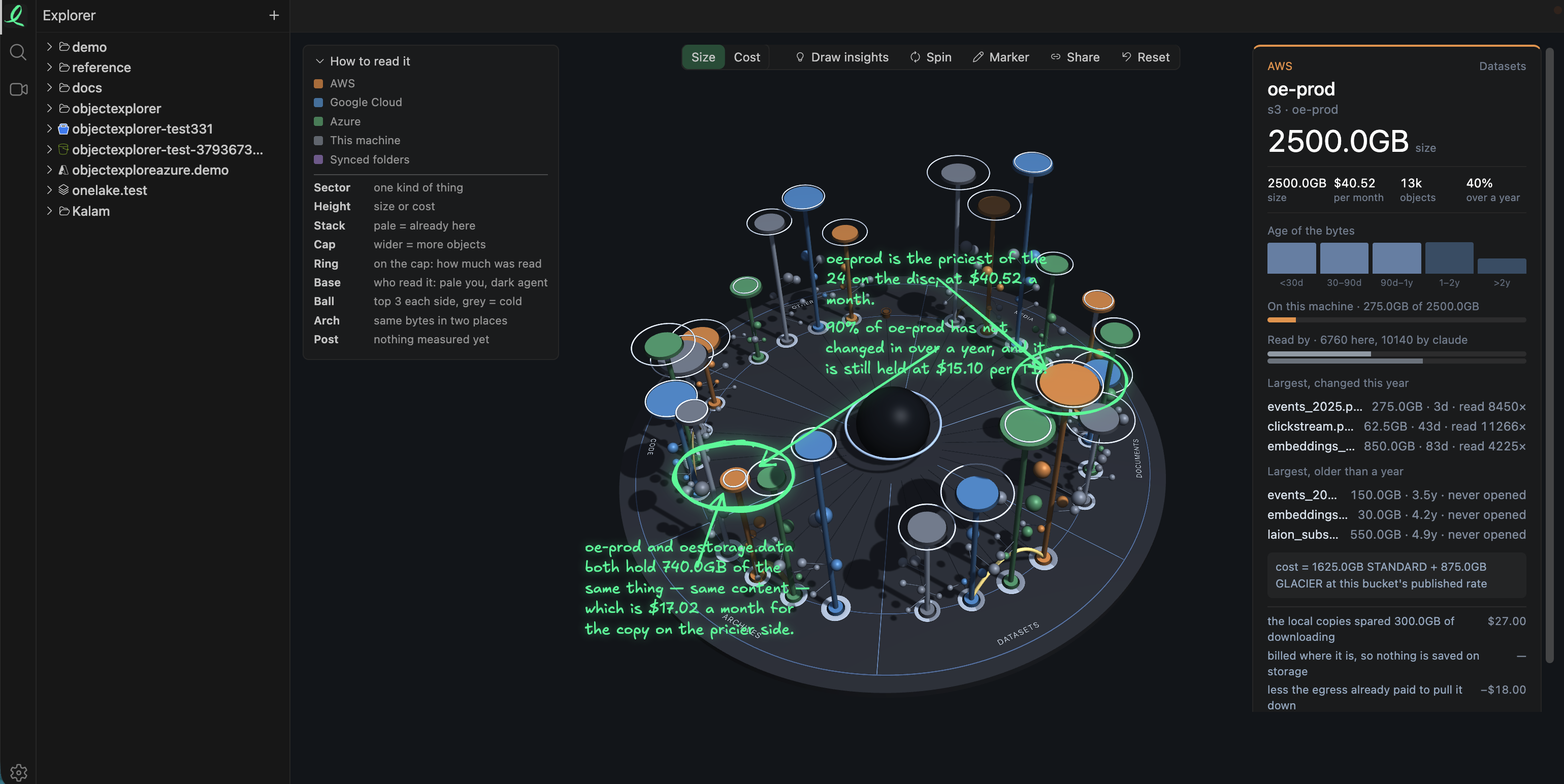
The agent never gets a credential and never talks to a provider. It asks this app, and this app answers — or refuses. Everything below follows from that one arrangement.
Why an agent should read through it
Only what you wrote down is reachable
No rule file means the door is shut. A file with no roots in it means nothing is reachable. What an agent may see is one list of roots you ticked, minus one deny list that holds in every root — so .env, *.pem and anything with secret in the path is refused wherever it lives, in a bucket nobody remembered to think about.
There is no path where an agent reaches storage without passing that gate, because the gate sits where the bytes are rather than inside each tool. A SQL statement naming a denied object is denied at the same step a byte range would be.
→ The rule file, connecting an agent
Every access is recorded, watchable live, and replayable
One line per call — what was asked, which rule decided it, how many rows and bytes went back — written and flushed before the answer leaves the server. A process that is killed still has everything it answered.
While an agent works you can watch it: the window follows what it opens, in the window, as it happens. Afterwards, a session opens as a tab — the client's own transcript beside our log of what it actually reached — and Replay opens again, in order, everything the agent opened. Recheck re-issues the recorded calls against today's rules and reports which decisions moved.
PII is sanitized on the way out, by configuration
A rule says which values it catches and what happens to them: FPE (a different value of the same shape), Hash, Mask (a range of characters), or Drop. Two ways to name a value, because there are two kinds of data:
- Tabular — matched on the column name, anywhere in it, so one
emailrule catchesemailAddressandbillingEmail. Every value in that column goes through it. - Full text — matched on what a value says. A note with a customer's address and personal number in it comes back as the same note with those gone, and the rest of the sentence intact.
FPE is the default because it is the only action that leaves the data still usable: same length, same alphabet, equal values still equal — so a query still joins, still groups, still counts. Every rewritten column is named as encrypted in the result, so an agent never quotes a fake id back to a person as a real one. The same rules protect the other audience too: a person opening a share link gets what they say, under a key made for that one share.
It can read the formats an agent cannot
An agent with a shell and a cloud SDK can fetch bytes. What it does with a sas7bdat, a .sav, an ORC file, a Hudi folder or a 3 GB Parquet file is the actual problem — and "pip install something and write a script" is where the tokens and the mistakes go.
Every parser this app has is on the other side of that door: Parquet, Avro, ORC, Arrow, SPSS, SAS, Delta, Iceberg, Hudi, archives, spreadsheets, documents. An agent asks in SQL and gets rows. The range of data it can reach at all is the whole format list, not the subset it happens to have a library for.
Limits, for safety and for cost
Rows per call, bytes per call, bytes per session, bytes per day, calls per minute, objects per listing, and a largest-object ceiling. Counted on the way out — what the agent received, not what the app read, so a cache hit costs the same as a download.
Two problems, one dial. An agent that walks a bucket one refusal at a time is stopped by the same number that stops an agent from pouring a 400 MB table into a context window you are paying for.
→ Limits
Column summaries, so it looks before it reads
columnSummary hands back per-column statistics — type, nulls, distinct, min, max, the common values — measured after the PII rules, never before. It is the cheapest call in the set and it is usually the one that answers the question.
An agent that can see a column's shape asks for the right thousand rows. One that cannot, asks for all of them.
What it costs to try
Settings → MCP, one toggle, one tick per client. The starting rule file grants the folders already in your window, turns query and getObject off, and leaves the door shut until you open it.
MCP is in the desktop app and npx. The browser version has no agent on the machine to hand anything to, so it has no MCP pane at all.
Next: connecting an agent.