 ObjectExplorer
 PII rules
Settings → PII. What never leaves this machine as it stands.
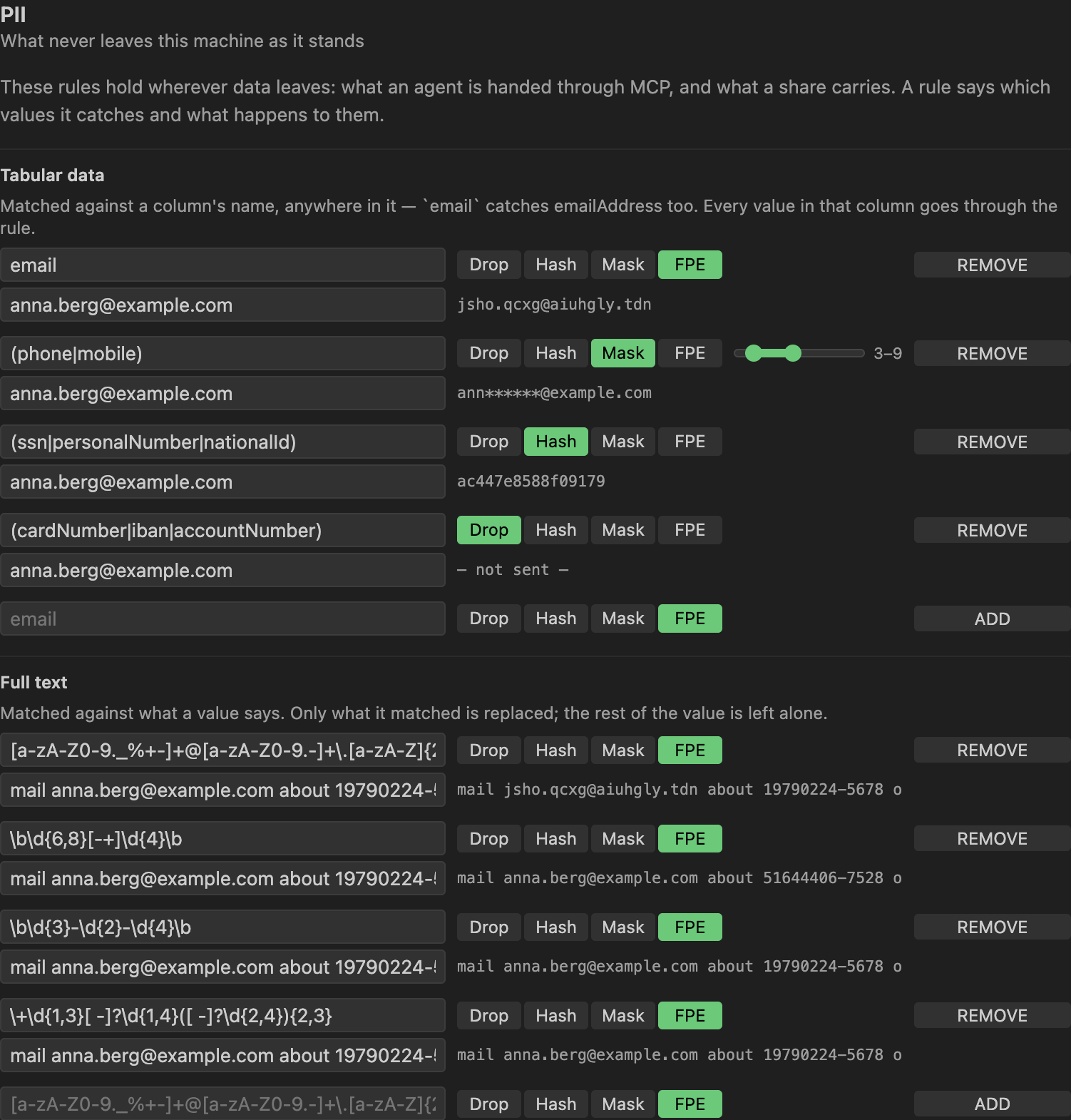
One set of rules protects two audiences: an agent calling over MCP, and a person opening a share link. Both are data leaving this machine, and both go through the same code in the app's own server, reading the same two lists from the same file, ~/.objectexplorer/mcp.yaml. Someone who decides once that email is never shared plainly has decided it for both. An edit in the pane holds from the next call or the next share — the file is read again every time, with no restart.
| An agent over MCP | A person with a share link | |
|---|---|---|
| Which rules | both lists, on every call | both lists, on every share |
| Who can loosen one | nobody — no call can ask for less | the sender, one column at a time, for that one share |
| A rule that says drop | the column is not in the answer at all | opens as Hash — a share cannot leave a column out yet |
| The key | one per install, in ~/.objectexplorer/mcp/key | one per share, made when the dialog opens, never in the link |
| How it is told | every rewritten column is marked encrypted: true | a rewritten column reaches the receiver's grid as text |
Everything else is the same: the four methods below, the 16 hex characters a hash comes back as, the characters a mask hides, and the full-text rules — which hold over a share even for a column set to None.
Two lists, because there are two kinds of value
Tabular — matched against a column's name, anywhere in it. email catches email, emailAddress and billingEmail. Every value in that column goes through the rule, whatever the value says.
Full text — matched against what a value says. Only what it matched is replaced; the rest of the value is left alone. A note field with a customer's address and personal number in it is exactly the case this is for:
mail anna.berg@example.com about 19790224-5678 or call +46 73 987 65 43
mail kxnh.qtay@zbmwuxe.tqf about 84013557-1092 or call +19 04 246 71 88
A starting rule file ships four of each — column rules for email, phone, national id and card or account number, and text rules for an email address, a personal number, a US SSN and an international phone number — because a file with only column rules looks like it works right up until the day it does not.
Four methods
| Method | What comes back | Keeps |
|---|---|---|
| FPE | a different value of the same shape | format, joins, counts |
| Hash | 16 hex characters of keyed SHA-256 (HMAC) | joins, counts |
| Mask | a range of characters hidden, the rest kept | shape |
| Drop | the value never leaves — the column is not in the result at all | nothing |
Drop is for an agent. The share dialog offers None, Mask, Hash and FPE, and a column a rule drops opens there as Hash — see the table above.
FPE is the default, and a rule that names no method gets it. It is the only one that leaves the data still looking like data: a masked column breaks a join and makes every distinct count 1, and a hashed card number is something no analysis can sanity-check — so an agent handed either of them asks for the raw file instead. Format-preserving encryption keeps the length, the alphabet and the equality, and gives up nothing real.
Where there is no format to preserve — a float, a timestamp, a blob — the value is hashed instead. That is the one place a method is decided for you.
Mask carries a range, dragged on a two-handle slider: the characters between the handles become stars and the rest is kept. The range can never close to nothing — a mask that hides no character is a rule that reads as set and does nothing.
Every rule shows its own sample, rewritten as you change it by the same code a call or a share goes through. The sample uses this install's key, so it is exactly what an agent gets; a share's Hash and FPE values read differently, because a share has a key of its own.
Where the key lives
Hash and FPE are both keyed, and the key is the one place the two audiences part.
An agent is answered under one key per install, generated on first use and kept in ~/.objectexplorer/mcp/key — never in the rule file and never on the wire. So an encrypted value is stable across sessions on this machine, and means nothing on any other.
A share is encrypted under a key of its own, made when the share dialog opens. It never enters the link; Copy key is the only way it leaves the browser. So a receiver given that key holds that one share and nothing else, and the same email hashed in two shares, or in a share and an agent's answer, comes back as two different values that cannot be joined.
What an agent is told
Every column a rule rewrote is marked encrypted: true — in describeObject, in columnSummary and beside query results. An agent holding a customer id that is not the customer id has to be told, or it will hand it to a person as a real one.
columnSummary is measured after the rules, never before. The top values of the real column would be precisely the leak the rules exist to stop.
What the rules cannot reach
getObject reads a whole object and answers as what it is: rows for a table, which go through the column rules; text for a document, which goes through the full-text rules; a tree for a drawing, and a window of bytes for anything else. Those last two go through neither — there is no column to name and no sentence to find an address in, and scrambling them would only break the file.
That is why a starting rule file leaves getObject and query off, and why a root holding raw exports is a place for an approve rule.
Next: sessions, replay and audit.