 ObjectExplorer
Science and machine learning
npy npz safetensors gguf fits mat nii nrrd zarr grib mtx, and genomics: fasta fastq bed gff3 gtf vcf sam bam
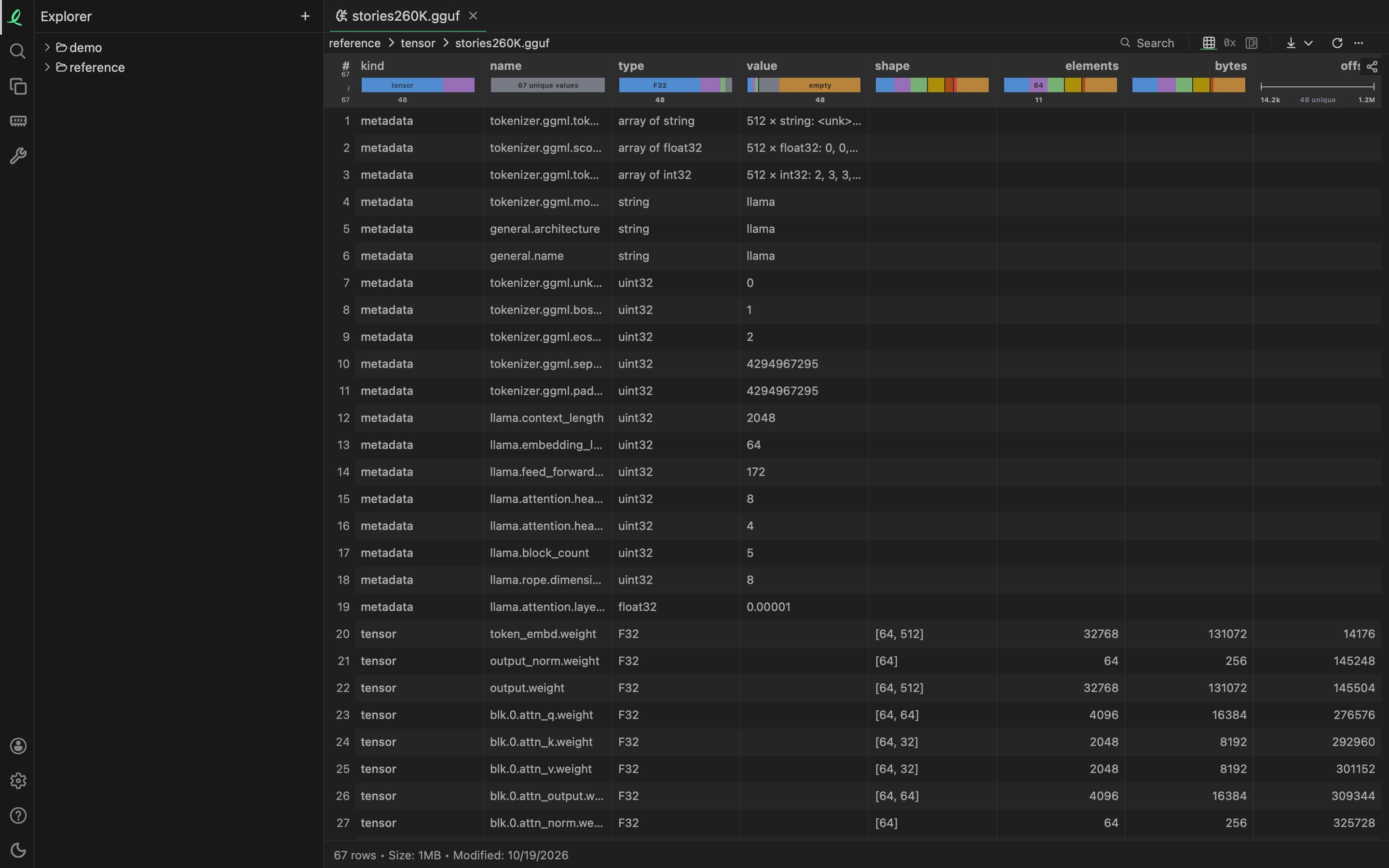
Arrays, model weights, sky images, brain scans, weather grids and sequencing reads open as what they hold, read on your machine — no Python, no notebook to set up first. Which reader a file needs, its first bytes decide.
Arrays and model weights
| File | Opens as |
|---|---|
NumPy npy | its elements as rows, a page at a time at any size; a picture first when it is one |
NumPy npz | a folder of its arrays, each opening as an npy |
safetensors | a table of its metadata and tensors: name, type, shape, elements, bytes and offset |
llama.cpp's gguf | the same table: the model's settings, then every tensor, quantized ones named by their type |
MATLAB mat (version 4 and 5) | a sheet a variable: numbers, text, sparse matrices, cells and structs |
Matrix Market mtx | a row per entry — row, column, value — or the dense grid |
A 2-D NumPy array is a row per row and a column per column; a structured one, a column per field. An array shaped like a picture — height × width × 1, 3 or 4 bytes — opens as that picture, its rows next. An npy also opens in a notebook, for SQL over its elements.
A safetensors or gguf file is read only as far as its header: the weights are never loaded, so a model of many gigabytes opens at once. A shard of a split model says which one it is — "2 of 5". A long metadata list, like a tokenizer's vocabulary, shows its count and first values.
A MATLAB 7.3 file is HDF5 underneath and is not read as a mat; it says so.
Images and volumes
| File | Opens as |
|---|---|
FITS fits fit fts | its first image, with the header cards beside it; every part (HDU) as a sheet |
NIfTI nii nii.gz | the scan, slice by slice; the voxels and the header as tables |
NRRD nrrd nhdr | the same, the data read from the file the header names beside it |
Zarr zarr (version 2, zipped) | the array, slice by slice |
GRIB grib grb grib2 | its first parameter, longitude by latitude, a slice for each of its fields |
A volume opens on its middle slice. Axial, Coronal and Sagittal pick the plane, and a slider steps through each further axis — the slice, then the time. ← → step a slice, ↑ ↓ the time, PageUp PageDown a tenth of the way, Home End the first and the last. Every slice uses the same grey range, so two slices compare.
A FITS file is a series of header-and-data units (HDUs); a table among them — binary or ASCII — is a sheet with a column per field. GRIB editions 1 and 2 are read, simple packing and JPEG 2000 among their encodings; the file's other messages are listed in its facts.
Genomics
Every one of these opens as a table, a row per record, its text a click away:
| File | A row for each, with |
|---|---|
FASTA fasta fa fna faa | sequence: identifier, description, length, sequence |
FASTQ fastq fq | read, with its quality and the mean quality |
BED bed | region, in UCSC's column names, BED3 to BED12 |
GFF3 and GTF gff3 gff gtf | feature: the nine columns, and a column for each attribute |
VCF vcf | variant: the #CHROM columns and one per sample |
SAM sam, BAM bam | alignment: the eleven fields and a column per optional tag |
A record that is broken still shows as a row, with a last column saying what is wrong. A BAM's structure mode lays out its header, references and compressed blocks. A .vcf that is a contact card opens as one — see records and trees.
HDF5 and NetCDF files open in a notebook, a row for each dataset — see HDF5 and NetCDF.
Next: databases.