 ObjectExplorer
Medical and health
DICOM dcm dicom and a scan CD's DICOMDIR, brain volumes hdr img mnc mgh mgz, recordings edf bdf hea, messages hl7 x12 edi 837 835 astm, records fhir cdaccd ccda, a Garmin fit, an Apple Health export, and clinical trial data odm
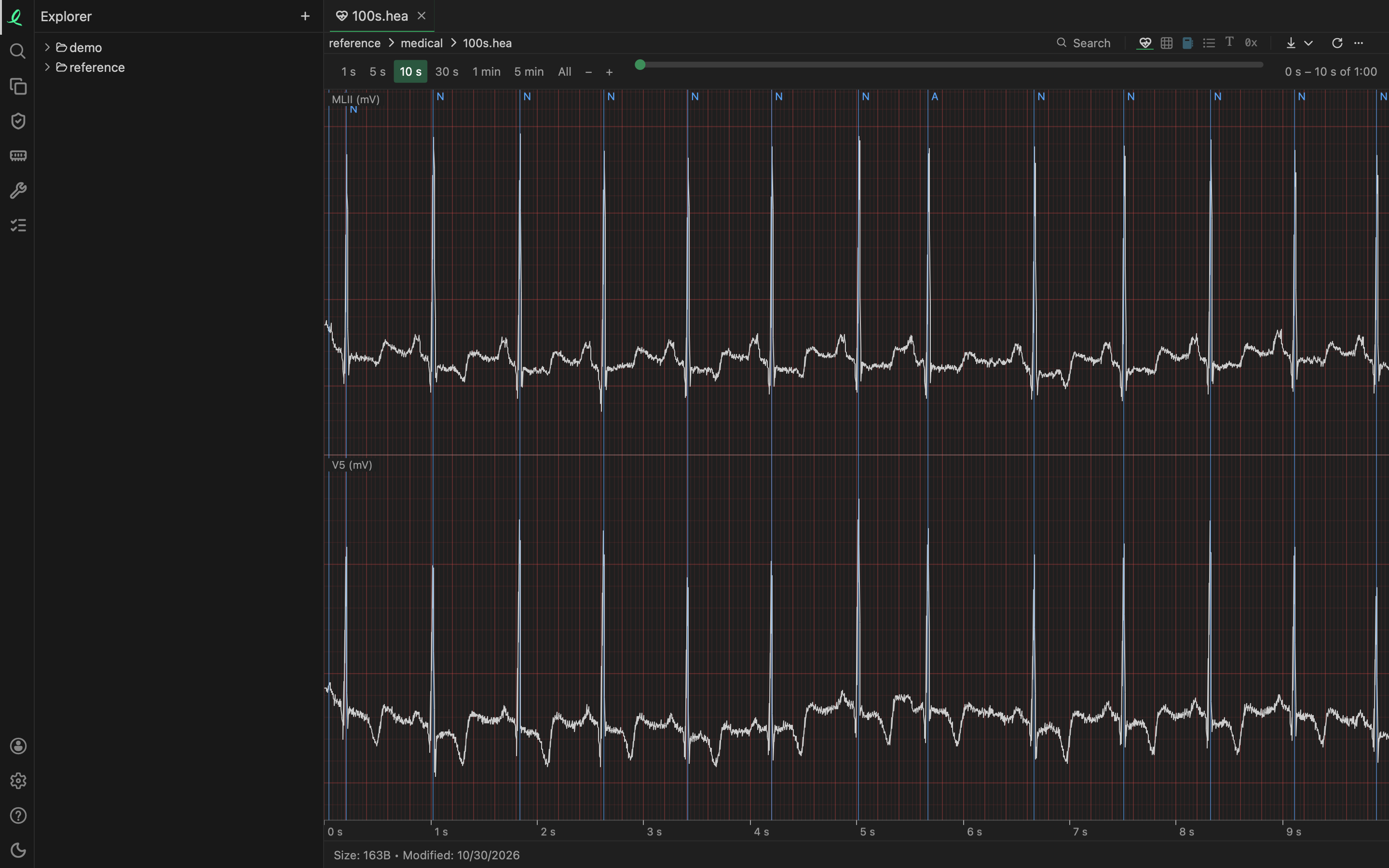
Scans, recordings and health records open as what they hold: the picture, the trace, the page. No viewer from the scanner's maker, no Python. Most of them are also a table, or a list of tables, that you query with SQL.
Which kind a file is, its bytes decide, not its name: a slice named IM0001, an HL7 message in a .txt, an ECG (a heart's electrical trace) in a plain .xml all open as themselves.
DICOM
DICOM (Digital Imaging and Communications in Medicine) is the format every scanner writes. A DICOM file opens as its picture, with a card of what it says of itself beside it: the modality, the study, the patient, the size.
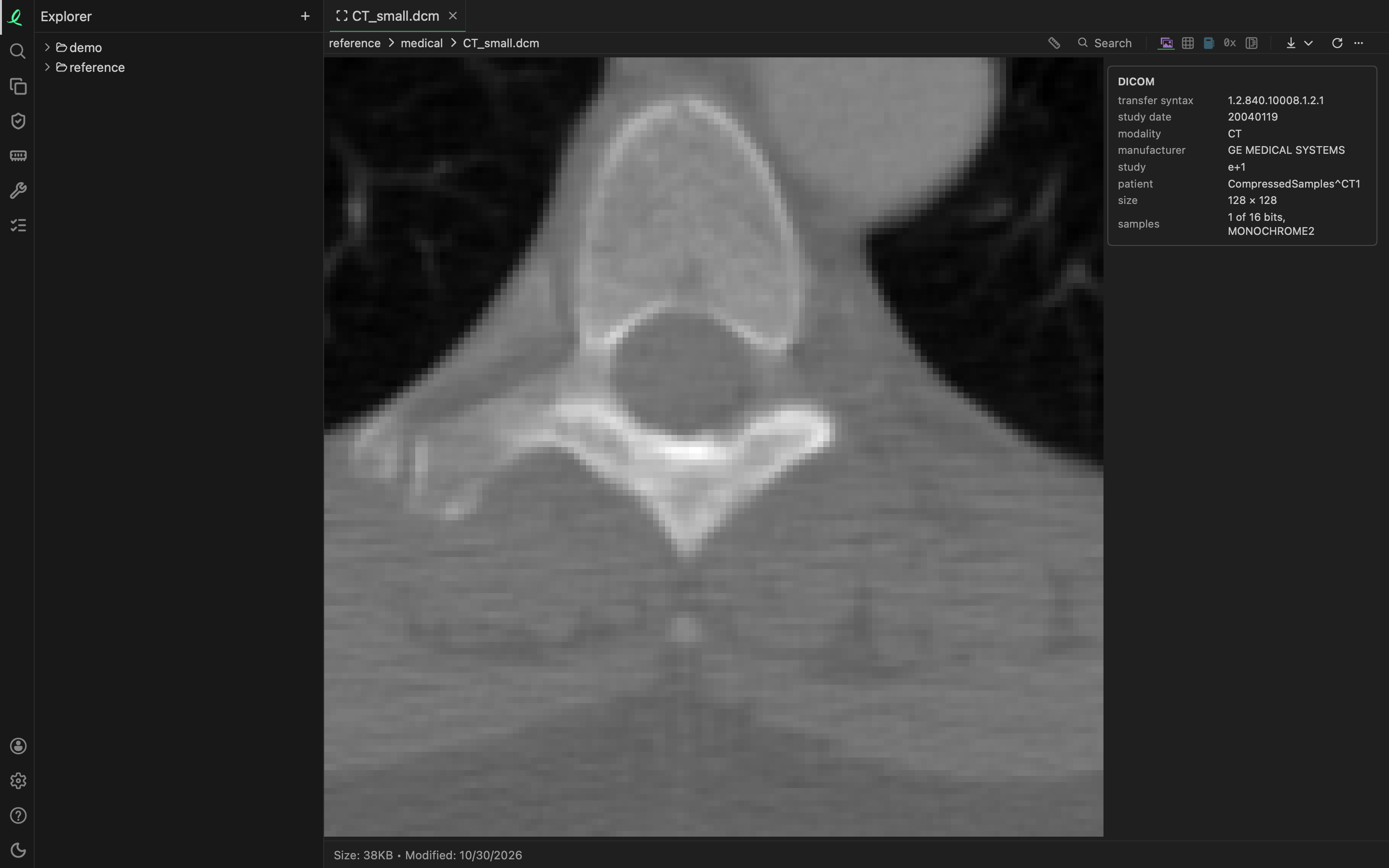
A file of many frames, or a slice whose folder holds the rest of its series, opens as a volume: the slices of the series in the order they lie in the body, on the middle one. The same keys as a volume's step through them, and Axial, Coronal and Sagittal cut it the other ways. Only the slice's own folder is looked in.
The row over the slider picks the window, the range of values shown from black to white: the windows the file names, and on a CT (computed tomography) scan the usual Brain, Soft tissue, Lung and Bone. Its level and width are written beside them. Drag over the picture to move it: across makes it wider or narrower, up and down raise and lower its level.
What a DICOM file holds besides a picture opens as that:
| The file holds | It opens as |
|---|---|
| a structured report | its page: the title, who and when, then its findings as written |
| an encapsulated PDF | the PDF's pages, in the PDF reader |
| an ECG or other waveform | its leads drawn, as a recording is |
| a plan, or nothing drawn | its elements' table |
The Table of any DICOM file is every element: its tag, its keyword, its type, its length, its value and the dictionary's name for it. Structure lays out the same elements where they lie in the file.
A scan CD's DICOMDIR opens as a folder a patient, inside it a study, inside that a series, each file opening as the slice it is. Its Table is a row a file, under its patient, study and series.
Pictures stored plain, run-length encoded, as JPEG (baseline, extended, lossless and JPEG-LS) or as JPEG 2000 are decoded. High-Throughput JPEG 2000, JPEG XL and frames stored as video (MPEG-2, MPEG-4, HEVC or H.265) are not, and the file says so. A colour series is shown a file at a time, not as a volume.
Brain volumes
Analyze 7.5 (an .hdr with its .img beside it), MINC 1 and 2 (.mnc, the Montreal Neurological Institute's format) and FreeSurfer's .mgh and .mgz open as the brain they hold, slice by slice, the same way as a NIfTI file: the middle axial slice first, Axial, Coronal and Sagittal to change the plane, and a card of the scan's facts. An .hdr that is a Radiance picture opens as one; the bytes tell them apart. The Table holds the voxels and the header.
Recordings
| File | What it records |
|---|---|
European Data Format, EDF and EDF+ edf, BioSemi's BDF bdf | EEG (brain waves), sleep and other signals, with annotations |
PhysioNet's WaveForm DataBase (WFDB): a .hea header, .dat .atr | ECG and other signals, with beat annotations |
HL7 annotated ECG (aECG), an .xml | a 12-lead ECG, its rhythm and its median beat |
| a DICOM waveform | an ECG kept in a DICOM file |
A recording opens drawn in Signals: a lane a channel, named with its unit, over a window of its time, the ruler under them and the annotations marked across. An ECG is drawn on its paper's squares.
The bar picks the window's length — 1 s to 5 min, or All — and − and + zoom. The slider moves the window. ← → move it a tenth, PageUp PageDown a whole window, Home End go to the start and the end, and the wheel moves it (with ⌘ or Ctrl, it zooms). A file of several sample rates, or an aECG's rhythm and median beat, has a choice of them on the bar. A long recording draws as fast as a short one: only the window shown is read.
A WFDB record opens from its .hea, or from the .dat or .atr beside it. Its Table is a table a sample rate (256 Hz: the time, then a column a channel), then annotations and channels; the notebook queries them. A file of annotations alone has nothing to draw, says so, and shows them on its Table.
Messages between hospital systems
| File | A table for each |
|---|---|
HL7 (Health Level Seven) version 2 hl7 | segment type: MSH, PID, OBX … |
X12, the claims and remittances insurers exchange, x12 edi 837 835 | segment id: ISA, CLM, NM1 … |
ASTM E1394 (the American standard lab instruments report in) astm | record type: Header, Patient, Order, Result … |
A message file opens as the list of its tables, as an SQLite file does. A double click opens one on its Table, a row a segment or record, and its notebook queries it by its name after the file's path: SELECT * FROM 'lab/results.hl7/OBX'. An HL7 table's columns are named as version 2.5.1 names its fields (patient_name, date_time_of_birth), and a value keeps its components as written (EVERYMAN^ADAM). An HL7 file's Structure is its messages, each with its segments and their titles.
These files often come as .txt or .log: they open as themselves all the same.
Health records
A FHIR (Fast Healthcare Interoperability Resources) file, release 4 or 5, in JSON or XML — one resource or a Bundle of them — opens as a page: a chapter a resource, its narrative as written, its fields a table where it has none. The contents beside it list the resources. Its tables are next, one a resource type (Patient, Observation …), a column a field's path; a JSON file's JSON laid out after them.
A clinical document — CDA (Clinical Document Architecture) release 2: a C-CDA (Consolidated CDA) or a CCD (Continuity of Care Document) — opens as its page: its header (patient, author, codes) as a table, then a chapter a section with its narrative. Its tables are document, sections and entries.
Both are told by what is inside, so an .xml or a .json opens as one when it is one.
Health and fitness data
A Garmin FIT (Flexible and Interoperable Data Transfer) activity, .fit, opens on its track, drawn as a map. Its message types are its tables next — record, lap, session … — a column a field, the positions and times as the device wrote them. A FITS sky image (astronomy's Flexible Image Transport System) named .fit stays a FITS image.
An Apple Health export (the export.xml in the zip the Health app writes) opens as the list of its tables, a kind of element each, in the order they first come: ExportDate, Me, Record … Its Table opens on the one of the most rows.
Clinical trial data in the formats of CDISC (the Clinical Data Interchange Standards Consortium): an ODM (Operational Data Model) file, Dataset-XML or Define-XML is a table an item group, a column an item; a Dataset-JSON file is its one table.
Next: records and finance.