 ObjectExplorer
Records and finance
Bank statements ofx qfx qif sta mt940, ISO 20022 statements and payments in .xml, books gnucash beancount bean ledger hledger journal, financial reports xbrl and inline XBRL pages, event logs evtx journal, bibliographies bib bibtex ris nbib medline ciw enwrefer
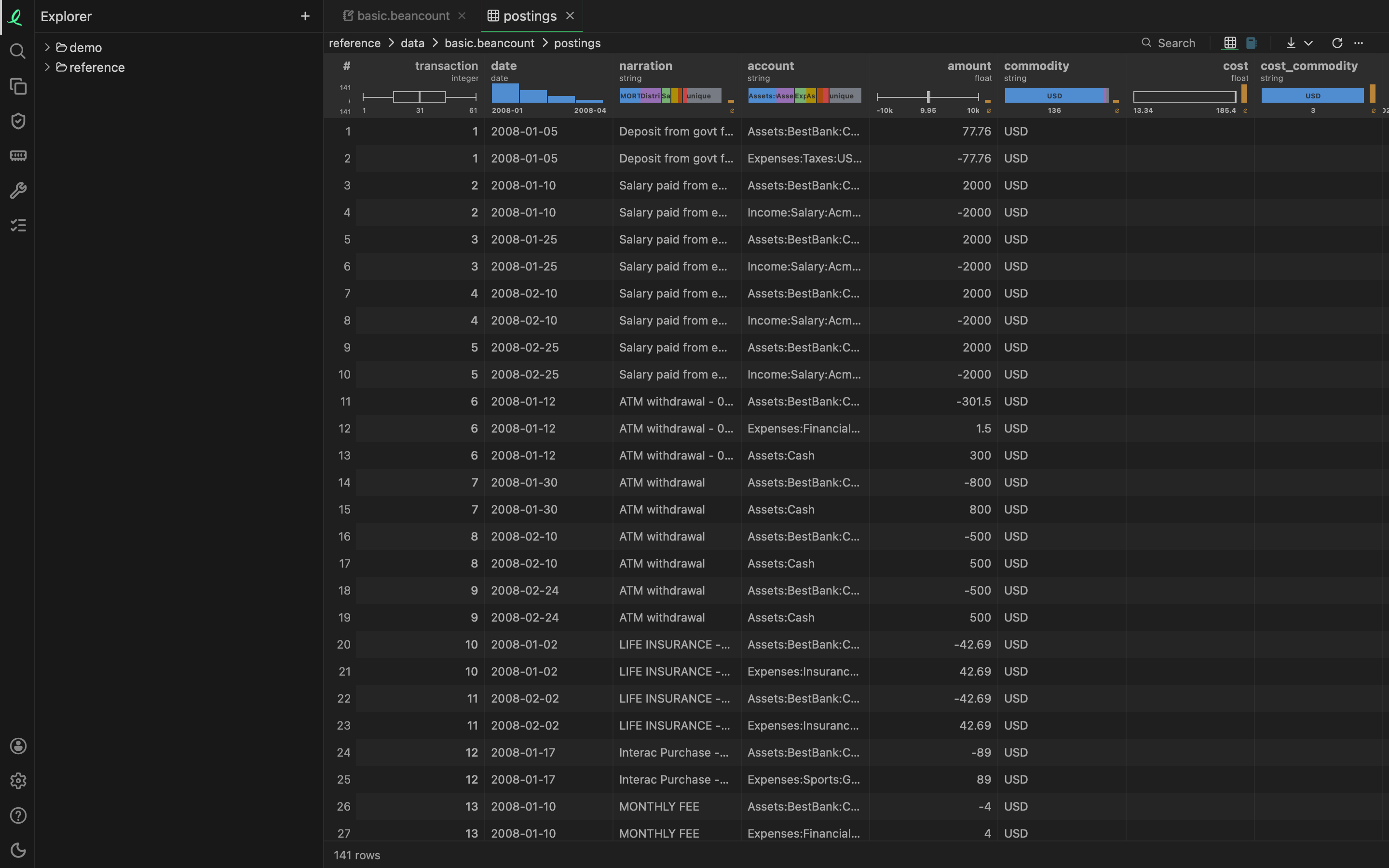
Files that are lists of records — a transaction, an event, a reference — open as their table, a row a record, read by the app's own engine. The same column summaries and SQL as a parquet file work on them: a bank statement and a csv of receipts join in one query.
A file that holds several kinds of record opens as the list of its tables, as an SQLite file does. A double click opens one on its Table, and the notebook queries it by its name after the file's path: SELECT * FROM 'books/home.beancount/postings'. Opened from its Table mode, such a file shows the table of the most rows.
Which format a file is, its content decides: an ISO 20022 statement named .xml, an hledger journal named .journal, a PubMed export named .txt all open as themselves. The text of the ones written as text is a click away.
Bank statements and payments
ISO 20022 is the international standard for messages between banks and their customers; SWIFT (the Society for Worldwide Interbank Financial Telecommunication) is the network banks send theirs over.
| File | A row for each |
|---|---|
OFX (Open Financial Exchange) ofx, Quicken's qfx | transaction, with its account |
Quicken's interchange file qif | transaction |
SWIFT MT940, the statement banks send over SWIFT, sta mt940 | statement line, with its statement |
ISO 20022 camt.052, camt.053, camt.054 statements, .xml | tables: entries, details, balances, statements |
ISO 20022 pain.001 payment orders, .xml | tables: payments, instructions |
OFX versions 1 (SGML, XML's forerunner) and 2 (XML) are both read; Microsoft Money writes the same. An amount is a number, signed as the bank books it, and a date is a date.
Books and journals
| File | Its tables |
|---|---|
GnuCash book gnucash (XML, compressed or not) | splits, transactions, accounts, prices, commodities |
Beancount ledger beancount bean | postings, transactions, accounts, balances, prices |
Ledger and hledger journals ledger hledger journal | postings, transactions, prices |
A posting carries its transaction's number, date and description, so the postings table alone answers most questions. An amount the journal leaves out is filled in, as Ledger and Beancount would balance it. A GnuCash book saved as SQLite is an SQLite file, and opens as its own tables.
A .journal is told by its bytes: a systemd journal opens as its log entries, an hledger journal as its tables.
Financial reports
An XBRL (eXtensible Business Reporting Language) report — .xbrl, or an .xml whose root says so — opens as its facts, a row each: the concept, its value, its period, its unit and its dimensions. An inline XBRL page, the .htm a company files with the SEC (the US Securities and Exchange Commission), opens as the web page it is, its facts on its Table next.
Event logs
| File | A row for each |
|---|---|
Windows event log evtx | event: provider, event id, level, time, computer, its data |
systemd journal journal, journal~ | entry, as journalctl -o json writes it |
A Windows event's own data is a column of JSON, a member a field. A journal's fields are a column each, and a payload compressed with LZ4, Zstandard or XZ is read. A log cut short reads as far as it goes.
Bibliographies
| File | A row for each |
|---|---|
BibTeX bib bibtex | entry: its type and key, a column a field |
RIS (Research Information Systems) ris: EndNote, Zotero, Mendeley | reference, a column a tag |
PubMed's MEDLINE format nbib medline | citation, a column a tag |
Web of Science plain text ciw | record, a column a tag |
EndNote tagged and Refer enw refer | reference, a column a tag |
A tag given more than once, as each author is, keeps its values in one column, joined by ; .
A browser's history and bookmarks open as tables too — see mail, chats and personal files.
Next: databases.